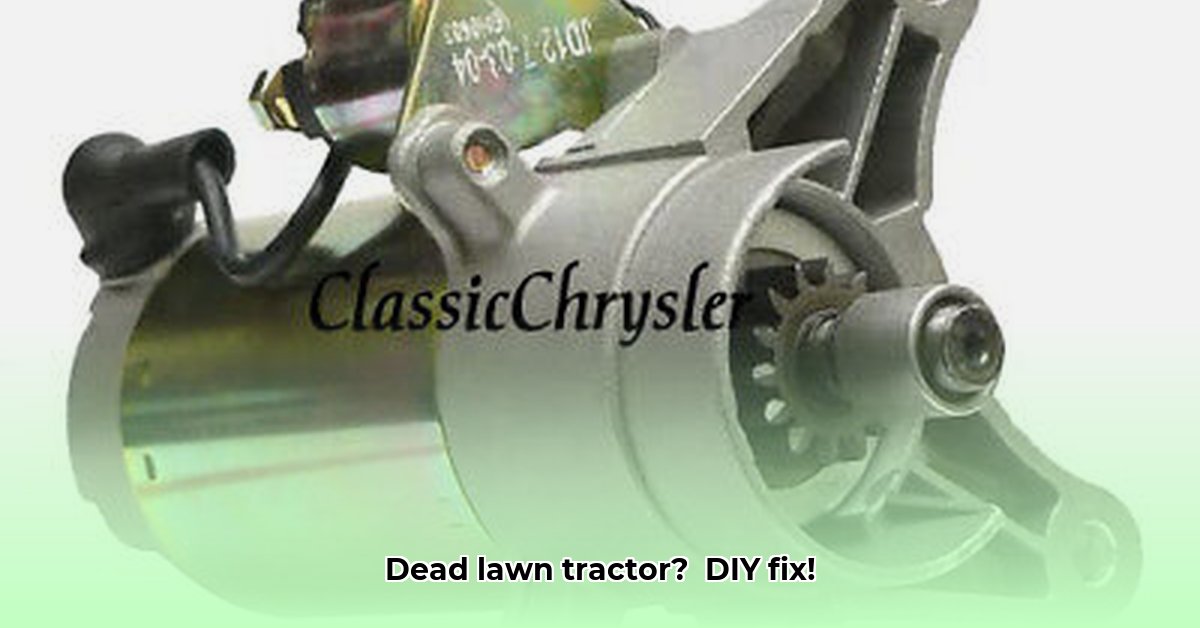
Diagnosing the Problem: Is It Really the Starter?
Before diving into a starter motor replacement, let's ensure the culprit is indeed the starter. A malfunctioning starter often presents itself in a few ways: the engine doesn't crank at all, it clicks without cranking, or it cranks slowly. However, don't jump to conclusions! A weak battery can mimic these symptoms. Did you recently check your battery's voltage? A simple multimeter test will tell you if your battery has sufficient charge (it should read at least 12 volts). Addressing a low battery will prevent unnecessary work. For other lawn tractor maintenance, see our guide on drive belt replacement.
Safety First: Essential Precautions
Before commencing any repair, prioritize safety. This is non-negotiable. What crucial step do you need to take before even thinking about touching a wrench? Absolutely, disconnect the spark plug to prevent accidental starts. This is paramount to protect yourself from potential injuries. Safety glasses are another must-have to safeguard your eyes from flying debris or metal fragments. Finally, work gloves protect your hands from grease and potential cuts.
Tools and Parts: Gathering Your Arsenal
To successfully replace your Briggs & Stratton lawn tractor starter motor, you'll need the following tools and parts. Remember to consult your owner's manual for model-specific requirements. What's the most critical component you need to buy? Precisely, a brand new Briggs & Stratton starter motor, matching your tractor's specific model number. Inexact matches lead to frustration.
- New Briggs & Stratton starter motor (correct part number essential)
- Socket wrench set (various sizes)
- Screwdrivers (Phillips and flathead)
- Wire brush (for cleaning terminals)
- Pliers (needle-nose pliers helpful)
- Owner's manual (your indispensable guide)
- Safety glasses
- Work gloves
- Penetrating oil (e.g., PB Blaster)
Step-by-Step Replacement: A Detailed Procedure
This section provides a step-by-step guide to replacing your lawn tractor's starter motor. Remember, each step is critical for a smooth, successful repair. What's the first crucial step to take in this repair process? Ensure your tractor is on a level surface, the parking brake is engaged, and you've disconnected the battery's negative (-) terminal.
Prep Work: Park on a level surface, engage the parking brake, and disconnect the battery's negative (-) terminal. This is crucial for safety.
Locate the Starter: Consult your owner's manual to locate the starter. It's usually near or beneath the engine. You might need to remove some components for access.
Disconnect Wires: Carefully disconnect the wires from the starter. Take photos or detailed notes of each connection. Labeling wires with masking tape and a marker is highly recommended.
Remove the Old Starter: Use sockets and wrenches to remove the starter's mounting bolts. Penetrating oil can help loosen stubborn bolts. Gently tap them with a hammer if needed.
Install the New Starter: Install the new starter, reversing the removal steps. Ensure proper alignment.
Reconnect Wires: Attach the wires, carefully matching them to your photos or notes. Double-check all connections.
Reconnect Battery: Reconnect the battery's negative (-) terminal.
Test and Verify: Attempt to start your lawn tractor. A smooth start indicates success. If not, re-check all connections. A loose or improperly connected wire can cause issues.
Troubleshooting Common Issues: Addressing Potential Problems
Troubleshooting is essential for successful repair. Let's examine some common issues and their solutions. What's the most likely reason your starter wouldn't engage? A low battery voltage, loose or corroded wire connections, or solenoid issues are prime suspects.
- Starter Doesn't Engage: Check battery voltage, wire connections, and the solenoid (a small electromagnet activating the starter).
- Starter Clicks, No Crank: This usually indicates a low battery or a faulty solenoid. Test the battery; replacement might be necessary.
- Starter Cranks Slowly: This suggests a weak battery. Charge or replace it.
DIY vs. Professional: Weighing Your Options
While a DIY repair saves money and offers a sense of accomplishment, professional help might be preferable if you lack experience or encounter unexpectedly complex problems. Consider the pros and cons carefully. What is a significant advantage of attempting a DIY repair? It substantially reduces costs. However, remember that the risk of mistakes exists.
| Pros of DIY Replacement | Cons of DIY Replacement |
|---|---|
| Lower cost | Requires mechanical skill and patience |
| Personal satisfaction | Risk of mistakes and potential further damage |
| Knowledge acquisition | May require specialized tools |
| Incorrect assembly can worsen the problem |
This guide provides general instructions; model-specific details may vary. Always consult your owner's manual for complete information. Remember, if you're uncertain, seeking professional help is always the safest option.